
Natural Flavors in Tea: What Are You Really Drinking?
When you reach for a functional tea—whether you want something refreshing, calming, digestive, or simply enjoyable—you probably picture the ingredients printed on the package going directly into your cup.
Green tea. Ginger root. Hibiscus. Peppermint. Orange peel.
Then there is an ingredient that appears on countless food and beverage labels:
Natural flavors.
It sounds reassuring. After all, the word natural is right there.
But “natural flavor” does not mean the same thing as a whole natural ingredient. A dried strawberry and a natural strawberry flavor are not interchangeable. Neither are peppermint leaves and natural mint flavor.
And for anyone intentionally choosing a clean-label functional tea, that distinction is worth understanding.
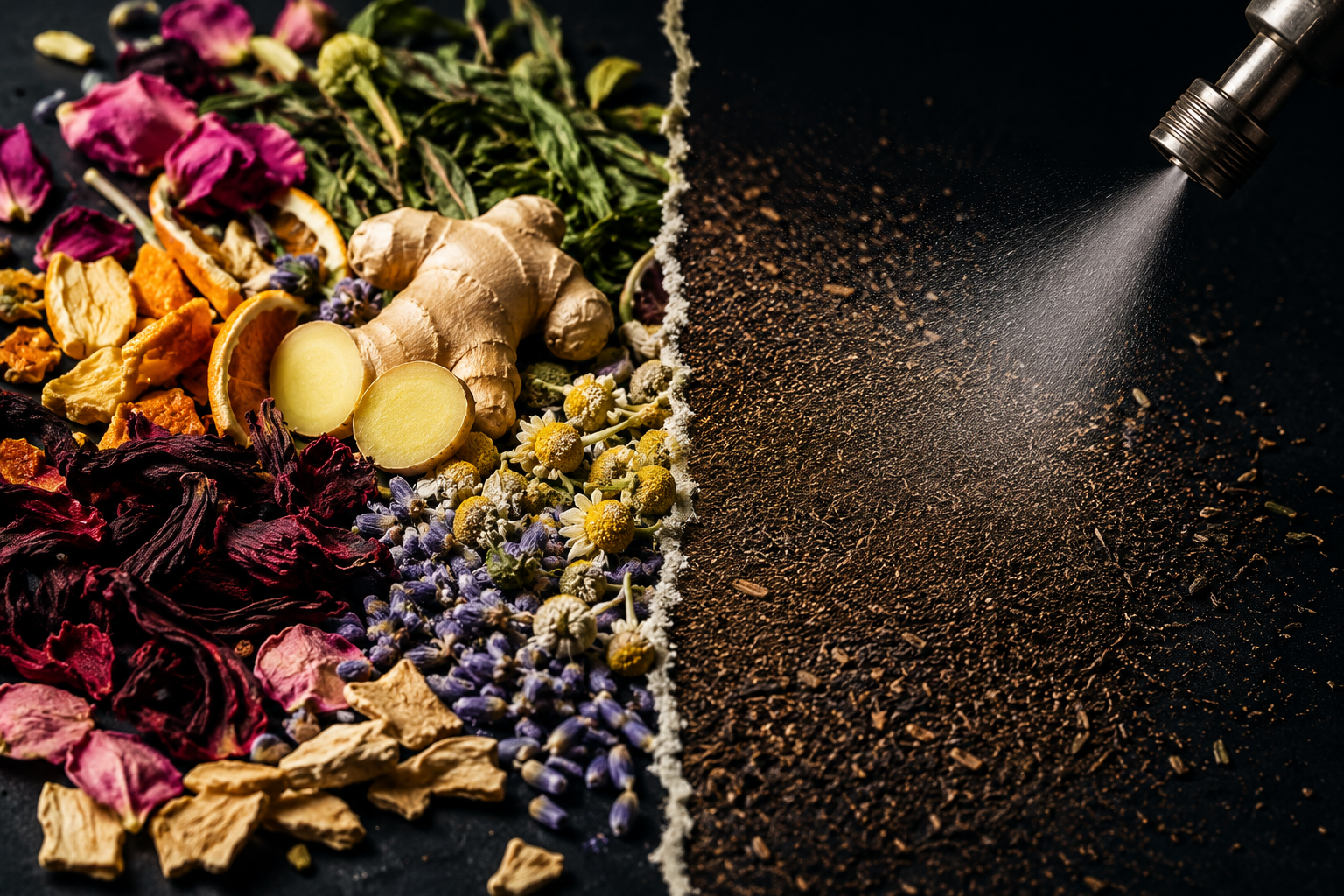
At Pure & Easy Tea, we believe the ingredient itself should create the experience.
If a tea tastes like ginger, there should be ginger in the blend.
If you smell lavender, you should be able to see lavender.
If orange gives the cup its brightness, there should be real orange peel inside the sachet.
Here is what “natural flavors in tea” actually means—and why we choose a different approach.
What Does “Natural Flavor” Actually Mean?
The U.S. Food and Drug Administration defines natural flavor under 21 CFR 101.22.
The definition includes flavoring substances derived from natural sources such as fruits, vegetables, herbs, roots, leaves, spices, bark, dairy products and fermentation products.
Those substances can take forms including essential oils, extracts, distillates, oleoresins and other processed flavoring preparations.
There is one particularly important part of the FDA definition:
Their significant function in the food is flavoring rather than nutrition.
That distinction matters.
Consider these two ingredient declarations:
Peppermint leaf
and
Natural mint flavor
Both may ultimately originate from plants. But they tell you two very different things about what is actually inside your tea.
Understanding natural flavors in tea starts with recognizing the difference between a flavoring preparation and the actual botanical itself.
One tells you that you are brewing the plant.
The other tells you that a flavoring preparation has been added to create or reinforce a particular sensory experience.
That does not automatically make natural flavor unsafe. It simply makes it fundamentally different from brewing the recognizable botanical itself.
“Natural” Does Not Mean “Whole”
This is where consumers can understandably become confused.
A flavor can legally qualify as natural even though it has undergone significant processing between its original agricultural source and the finished flavor ingredient.
A simplified comparison looks something like this:
Whole Botanical
Plant → Harvest → Dry/Cut → Blend → Brew
Natural Flavor
Natural Source → Extraction/Distillation/Processing → Flavor Preparation → Added to Food or Tea
Both may originate in nature.
Only one is necessarily the recognizable plant itself.
For consumers seeking tea without additives or added flavorings, that difference can be important.
A Special Note About Organic Tea
There is another distinction that deserves clarification.
Seeing “natural flavor” on a USDA-certified organic product does not mean manufacturers have unlimited freedom to use synthetic solvents, synthetic carrier systems or artificial preservatives.
USDA organic regulations place additional restrictions on flavors permitted in certified organic products. Nonsynthetic natural flavors may be allowed under specific circumstances, but they must meet National Organic Program requirements.
So the real question isn’t simply:
“Is natural flavor bad?”
A much more useful question is:
“Why is flavoring needed in the first place?”
That is where the difference between a flavored tea and a whole-botanical tea becomes more interesting.
Why Are Added Flavors Used in Tea?
Added flavors can serve several legitimate commercial purposes, which is exactly why natural flavors in tea are so common across the industry.
1. Creating Strong, Immediate Aroma
Flavor preparations can produce a pronounced aroma as soon as a consumer opens a tea package.
That is particularly useful when a company wants a highly recognizable strawberry, peach, vanilla, citrus or other flavor experience.
Whole fruit and herbs tend to behave differently.
Their aroma and taste emerge naturally during steeping and can be more nuanced than an added concentrated flavor.
2. Maintaining Flavor Consistency
Plants are agricultural products.
Rainfall changes.
Soil changes.
Growing regions differ.
Harvests vary.
One batch of strawberries will never be chemically identical to every strawberry harvested before it. Ginger from one growing season may be slightly more pungent than ginger from another.
Flavor formulations make it easier for manufacturers to produce a highly standardized sensory profile year after year.
Whole-botanical tea embraces more of the variation inherent in agriculture.
We consider that part of its beauty.
3. Controlling Cost and Formulation
Real botanicals occupy space and weight inside a blend.
Whole chamomile flowers, dried berries, citrus peel, ginger root, cardamom, lavender and other ingredients must be grown, harvested, transported, stored and blended.
Concentrated flavor ingredients can provide significant flavor with comparatively small quantities.
For large-scale food and beverage manufacturing, that can make formulation easier and more economical.
But economy and consistency are not the only ways to define quality.
Tea Dust and Fannings: What They Actually Are
Tea terminology creates another misconception worth clearing up.
Fannings and dust are primarily classifications based on particle size.
They are small particles of tea leaf and are frequently used in conventional tea bags because their greater surface area allows them to infuse very quickly and produce a strong cup.
Smaller leaf size does not automatically mean a tea is unsafe or poor quality, and a whole leaf does not automatically guarantee exceptional tea.
Origin, harvest, processing, storage and freshness all matter.
Where whole or larger botanical ingredients have an advantage is something much easier for the consumer to evaluate:
transparency.
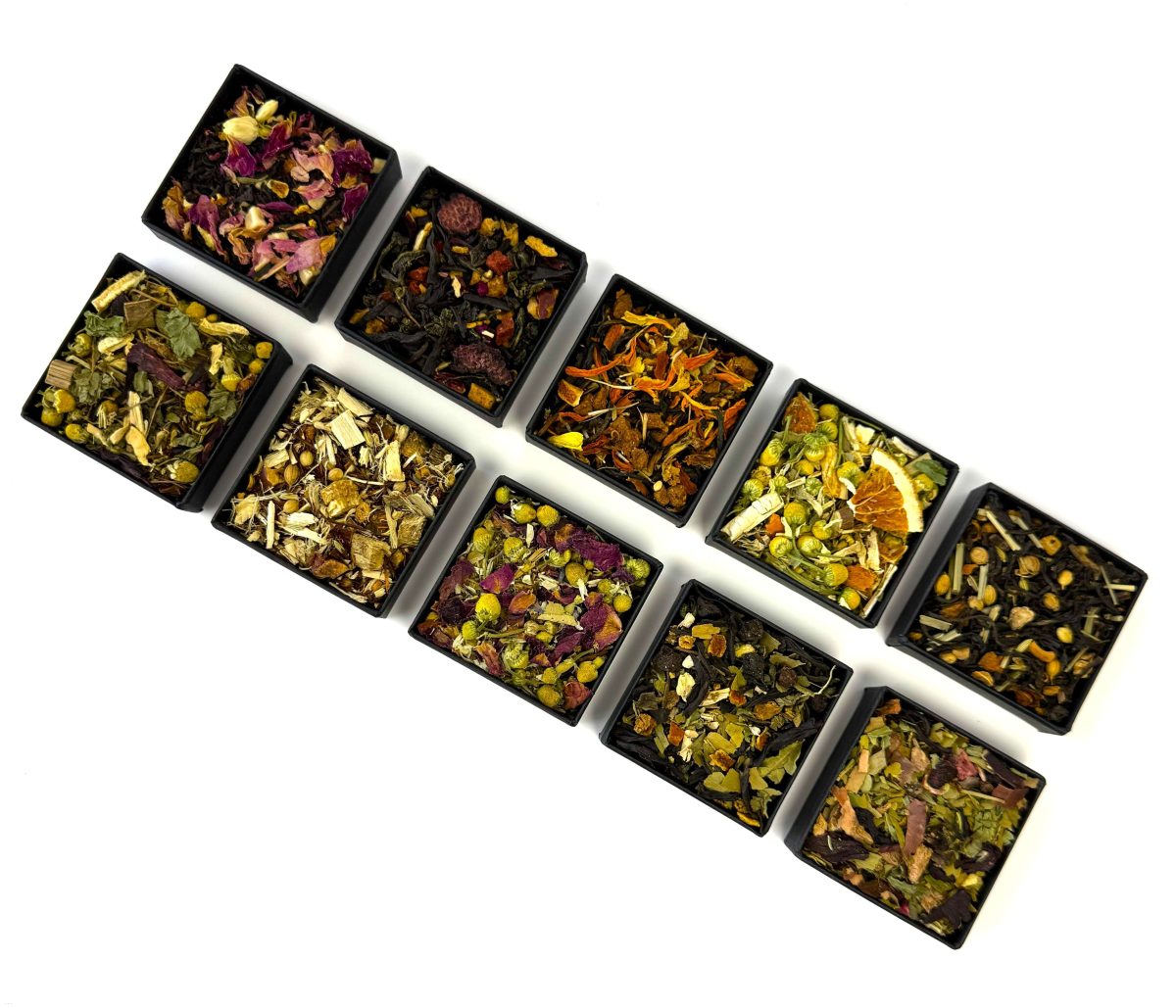
Open the sachet and look.
Can you see the ingredients the label promises?
That is one reason Pure & Easy Tea favors generously filled sachets and recognizable botanicals over natural flavors in tea.
We want you to see what you are drinking.
Whole Botanical Tea vs. Added Natural Flavor
| Whole-Botanical Tea | Tea With Added Natural Flavor | |
|---|---|---|
| What creates the taste? | The actual leaves, roots, flowers, fruits, seeds and spices | A flavor preparation added to the blend |
| Appearance | Ingredients may remain visually identifiable | Flavor itself generally cannot be identified visually |
| Aroma | Develops naturally from the ingredients | Can provide a strong, standardized aroma |
| Plant compounds | Brewing extracts naturally occurring compounds from the botanical | A flavor ingredient should not be assumed equivalent to the whole botanical |
| Consistency | Natural agricultural variation can occur | Designed for greater sensory consistency |
| Label transparency | Named plants tell you precisely what was added | “Natural flavor” can describe a broader flavor system |
| Pure & Easy Tea philosophy | Yes | No added natural or artificial flavorings |
The most important row may be the fifth.
A flavor derived from a botanical should never automatically be treated as nutritionally or functionally equivalent to consuming or brewing the botanical itself.
They are different ingredients serving different purposes.
The Full-Spectrum Difference
Plants are extraordinarily complex.
Take ginger.
Ginger root is not simply “ginger flavor.” It contains naturally occurring compounds including gingerols, shogaols and numerous other plant constituents.
Peppermint leaf is more than menthol.
Green tea is more than a green-tea aroma.
Hibiscus is more than a tart flavor.
When whole botanicals are steeped, hot water extracts an assortment of naturally occurring compounds from the actual plant material.
That is one of the reasons we believe functional tea should begin with the botanical itself rather than an approximation of its flavor.
If we want ginger in a blend, we use ginger root.
If we want the fragrance of lavender, we use lavender buds.
If we want tartness from hibiscus, we use hibiscus.
There is no need for the ingredient list to tell one story while the cup tells another.
Is Natural Flavor Harmful?
Whether natural flavors in tea are something to avoid is a fair question, and it deserves a responsible answer:
The presence of natural flavor does not by itself mean a product is harmful.
FDA regulations permit natural flavoring substances for use in foods, and natural and artificial food ingredients are subject to safety requirements.
Our objection is not that every natural flavor is dangerous.
It is about transparency, ingredient integrity and purpose.
For someone simply looking for a peach-flavored beverage, natural flavor may be perfectly acceptable.
But a consumer deliberately purchasing an herbal or functional tea may reasonably prefer to know whether the botanical pictured on the package is actually inside the sachet.
That is a very different standard.
And increasingly, consumers are asking for that level of transparency around natural flavors in tea.
How to Find Tea Without Natural Flavors
Fortunately, auditing your tea takes only a few seconds.
For consumers trying to avoid natural flavors in tea, the ingredient panel is the best place to begin.
1. Read the Ingredient List Literally
Don’t stop at the imagery on the front of the package.
Read the ingredients.
Compare:
Hibiscus, Rosehips, Natural Berry Flavor
with:
Hibiscus, Rosehips, Dried Elderberries, Orange Peel
The second list tells you exactly which plants are creating the blend.
Look for terms such as:
- Natural flavor
- Natural flavors
- Natural flavoring
- Artificial flavor
- Added flavor
If your goal is organic tea without natural flavors or another additive-free tea, those are the words to watch for.
2. Look Inside the Sachet
One of the simplest tests is also the most revealing.
Look at your tea.
Can you recognize leaves?
Roots?
Flowers?
Fruit?
Seeds?
Spices?
Whole-botanical tea should look like agriculture—not perfume.
The ingredients do not necessarily need to be completely intact. Botanicals are often cut into appropriate sizes so they can blend and infuse evenly.
What matters is whether the cup is genuinely being built from the plants listed on the package.
3. Ask What Creates the Flavor
If a tea is called blueberry, vanilla, peach, mango or lemon, look at the ingredient panel and ask:
What is actually making it taste that way?
Sometimes the answer is real fruit, peel, herbs or spices.
Sometimes it is natural flavor.
There is nothing complicated about the question.
The ingredient list should provide the answer.
4. Consider the Sachet Too
Ingredient purity is only one part of a thoughtfully made cup.
Consumers interested in clean-label tea may also want to investigate the materials used for the tea sachet itself.
Rather than assuming that terms such as biodegradable, plant-based and compostable mean exactly the same thing, check the manufacturer’s specifications and disposal instructions.
Packaging transparency should matter just as much as ingredient transparency.
Why Pure & Easy Tea Doesn’t Use Natural or Artificial Flavorings
If a tea tastes like a plant, why not use the plant?
Our approach to natural flavors in tea is deliberately simple.
We search the world for ingredients nature perfected and blend them with purpose.
No artificial flavors.
No natural flavorings.
No fragrance sprayed over the blend to make it smell like something it isn’t.
Instead, our teas are built from recognizable leaves, roots, flowers, fruits, seeds and botanicals selected to create both the flavor and the character of the cup.
That approach is more demanding.
Real ingredients take up more room.
They vary from harvest to harvest.
Some are expensive.
Some are fragile.
Some must be carefully balanced so that one botanical doesn’t overpower another.
But those challenges are part of making real tea.
When you open one of our blends, we want the experience to make sense.
You smell ginger because there is ginger.
You see lavender because there is lavender.
You taste citrus because there is real citrus peel.
What you see in the blend is what you smell and taste in the cup.
Nature Doesn’t Need a Flavoring Department
Tea existed for thousands of years before anyone needed to add “natural flavor” to an ingredient panel.
Leaves provided flavor.
Roots provided earthiness.
Flowers provided aroma.
Fruit provided brightness.
Spices provided warmth.
And water revealed all of it.
Modern flavor technology has an important place in the food industry. But it isn’t the only way to make something taste extraordinary.
We prefer the older idea.
Use extraordinary ingredients.
Ultimately, the conversation around natural flavors in tea comes down to transparency and what you want your cup to be made from.
For consumers searching for a clean-label functional tea, the simplest ingredient list can sometimes tell the most powerful story.
Turn the package around.
Read every word.
Look inside the sachet.
And choose a tea that doesn’t merely taste like nature.
Choose one made from it.
Keep reading