
What Tea Is Best for Sleep?
A warm cup of tea has long been part of the evening ritual for people looking to slow down, unwind, and prepare for bed.
But if you are asking what tea is best for sleep, the answer is more nuanced than simply reaching for anything labeled “sleep tea.”
The best nighttime tea starts with three things: caffeine content, the ingredients in the blend, and the ritual surrounding the cup.
Some teas naturally contain caffeine. Others are naturally caffeine-free herbal infusions. Some nighttime blends are built around a single familiar ingredient, while others bring together multiple herbs, flowers, roots, and botanicals traditionally associated with evening use.
Understanding those differences can help you choose a nighttime tea with more intention.

Start With Caffeine
Traditional tea comes from the Camellia sinensis plant. Black tea, green tea, white tea, oolong, and matcha all come from this same plant, and all naturally contain caffeine.
That does not make them bad choices during the day. It simply means they may not be ideal close to bedtime for someone who is sensitive to caffeine.
The National Heart, Lung, and Blood Institute, part of the National Institutes of Health, recommends avoiding caffeine close to bedtime as part of healthy sleep habits.
For that reason, many people looking for a nighttime tea choose a caffeine-free herbal infusion instead.
That distinction matters.
Chamomile, lavender, valerian root, lemon balm, passion flower, and similar botanicals do not come from the tea plant. Technically, they are herbal infusions or tisanes, although most people simply call them herbal teas.
What Makes a Good Nighttime Tea?
There is no single ingredient that automatically makes a tea ideal for bedtime.
A thoughtfully designed nighttime blend considers several things at once:
- Is it caffeine-free?
- What botanicals are included?
- How do those ingredients work together?
- Does the tea taste good enough to become part of a regular ritual?
- Are the ingredients being presented realistically?
Herbs such as chamomile and valerian have long histories of traditional use in nighttime preparations, but traditional use is not the same thing as proven treatment for insomnia.
The National Center for Complementary and Integrative Health notes that chamomile has traditionally been used for insomnia, often as tea, but clinical evidence remains inconclusive. Research on valerian has also produced inconsistent results.
That does not make these botanicals unimportant.
It simply means the most responsible way to talk about them is as ingredients traditionally associated with relaxation and nighttime use rather than as guaranteed sleep remedies.
The Botanicals Behind a Thoughtful Nighttime Blend
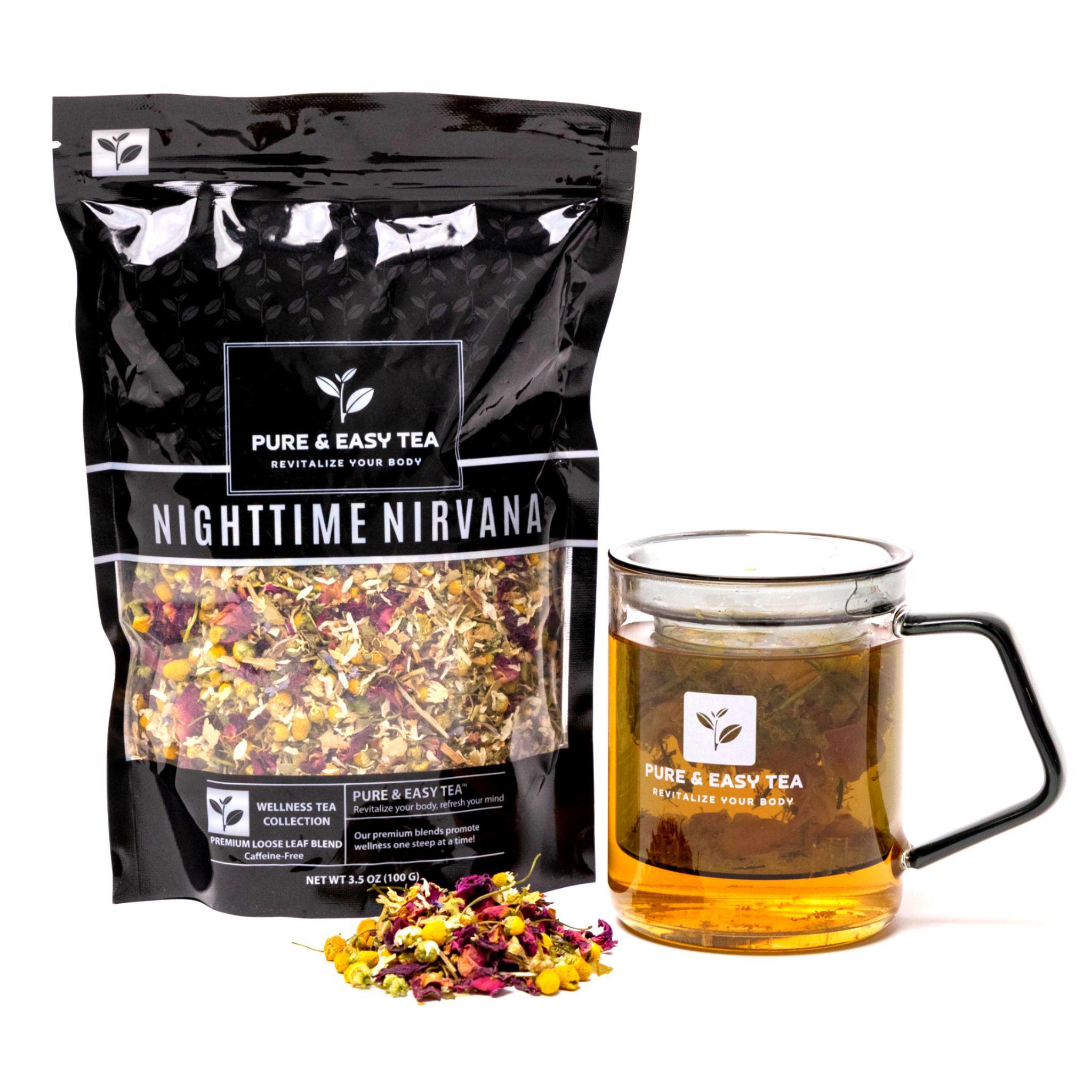
At Pure & Easy Tea, we created Nighttime Nirvana as a caffeine-free botanical blend built specifically for the evening ritual.
It brings together seven real ingredients:
Lavender, Chamomile, Linden Blossom, Valerian Root, Passion Flower, Lemon Balm, and Rose Petals.
Each contributes something different to the cup.
Lavender
Lavender is perhaps best known for its distinctive floral aroma and long association with calm, relaxation, and evening rituals.
It brings an aromatic quality to the cup that immediately signals something different from an everyday tea.
From a blending standpoint, lavender contributes far more than a wellness association. Its fragrance can help define the sensory character of the entire cup.
Chamomile
Chamomile may be the most recognizable botanical associated with nighttime tea.
It has been used for centuries in herbal preparations and remains one of the most common ingredients in caffeine-free evening blends.
Its soft floral character also pairs naturally with other nighttime botanicals, making it a natural foundation for a more complex blend.
Linden Blossom
Linden blossom has a long history of traditional use in herbal infusions and brings a delicate floral character to the cup.
It is less familiar to many American tea drinkers than chamomile or lavender, which is one reason it can add depth and distinction to a more complex nighttime formulation.
Its role is not simply functional. It contributes aroma, balance, and botanical complexity.
Valerian Root
Valerian root has one of the longest histories of use among botanicals traditionally associated with sleep.
It also has a strong, earthy character.
That makes balance especially important.
In a carefully formulated blend, valerian can contribute depth without overwhelming the other botanicals around it.
This is one of the reasons formulation matters.
A good botanical tea is not simply a collection of ingredients. It is a balance of flavor, aroma, texture, and purpose.
Passion Flower
Passion flower has traditionally been used in calming herbal preparations and continues to appear in many modern evening blends.
In Nighttime Nirvana, it is not treated as a single “hero” ingredient.
Instead, it becomes one part of a broader botanical composition designed to work as a whole.
Lemon Balm
Lemon balm belongs to the mint family and has a long history of use in traditional herbal preparations associated with relaxation.
Its bright, gently herbaceous character helps keep a nighttime tea from becoming overly floral or heavy.
That matters because a nighttime tea should not merely sound functional.
It should taste good enough that you actually want to prepare it again tomorrow night.
Rose Petals
Rose petals bring delicate floral aroma and refinement to the cup.
They also illustrate something important about complex botanical blending:
Not every ingredient needs to be included because it is being marketed around one specific benefit.
Some ingredients create balance, aroma, beauty, and an experience that makes the ritual itself more enjoyable.
That matters too.

Why Complexity Matters in a Botanical Blend
It is easy to look at a nighttime tea as a checklist.
Chamomile? Check.
Lavender? Check.
Valerian? Check.
But premium botanical formulation should go deeper than that.
Different ingredients bring different qualities to the cup.
Some are floral.
Some are earthy.
Some are herbaceous.
Some are aromatic.
Some dominate easily and must be carefully balanced.
The goal is not simply to put the maximum number of recognizable herbs into a bag.
The goal is to create a blend where the ingredients complement one another and the cup becomes richer, more layered, and more enjoyable as it steeps.
That is a central part of the Pure & Easy Tea philosophy.
We use real botanicals to create the flavor and character of the tea itself rather than relying on added natural or artificial flavorings to manufacture an experience around the ingredients.
What you see in the blend should be what you smell and taste in the cup.
Tea Can Be Part of a Nighttime Ritual Without Being a Sleep Treatment
There is an important difference between saying:
“This tea treats insomnia.”
and saying:
“This tea can become part of a relaxing nighttime routine.”
The first is a medical claim.
The second describes how people have used tea rituals for generations.
Healthy sleep guidance commonly recommends developing routines that help the body wind down before bed, including limiting caffeine late in the day and creating a more restful environment.
Preparing tea can fit naturally into that routine.
Heat the water.
Prepare the tea.
Allow it to steep.
Sit down.
Slow the pace of the evening.
For many people, the value of nighttime tea may be that it creates a deliberate transition between the activity of the day and the quiet of night.
In a world where it is easy to move directly from email, television, work, or a phone screen into bed, a deliberate pause can become meaningful.
What Should You Look for in a Tea Before Bed?
Choose Caffeine-Free When Appropriate
If caffeine affects your sleep, look for a blend that does not contain black tea, green tea, white tea, oolong, matcha, or another caffeinated ingredient.
A botanical infusion like Nighttime Nirvana is naturally caffeine-free because it contains no Camellia sinensis tea leaves.
Read the Ingredient List
Do not judge a tea only by the name on the front of the package.
Turn it over.
Look at what is actually inside.
Does the blend contain real herbs, flowers, roots, and botanicals?
Can you recognize the ingredients?
Are those ingredients doing the work of creating the aroma and flavor?
The ingredient list often tells you far more about a tea than the claims on the front of the box.
Look for Balance, Not One “Magic” Ingredient
A tea does not automatically become better because it contains chamomile, lavender, or valerian.
The quality of the formulation matters.
How do the ingredients work together?
Does one ingredient overpower everything else?
Does the tea become richer and more interesting as it steeps?
Does it have enough depth to become part of a nightly ritual?
Those are more meaningful questions than whether one trendy ingredient appears on the label.
Give the Botanicals Time to Steep
Botanical blends often contain ingredients of different densities and structures.
Flowers, roots, leaves, and blossoms do not all infuse at exactly the same rate.
Giving a complex blend more time can allow its character to develop.
With high-quality whole botanicals, a longer steep can produce a deeper, richer cup rather than simply making it harsh or one-dimensional.
Make the Tea Part of the Ritual
The tea itself is only one part of the evening.
Dim the lights.
Step away from your phone.
Prepare your tea slowly.
Read.
Listen to music.
Talk with someone.
Sit quietly.
The goal is not to transform a cup of tea into medicine.
The goal is to create a repeatable signal that the day is winding down.
Is Chamomile the Best Tea for Sleep?
Chamomile is probably the ingredient most people associate with bedtime tea, but there is no scientific basis for declaring one botanical tea universally “best.”
Chamomile is naturally caffeine-free and has a long history of traditional nighttime use.
But current research does not establish chamomile as a treatment for insomnia.
So perhaps the better question is:
What kind of nighttime tea will you actually enjoy enough to make part of your routine?
For some people, that may be simple chamomile.
For others, a more complex formulation containing several complementary botanicals may create a much more satisfying cup.
What About Valerian Root?
Valerian is another ingredient commonly associated with nighttime use.
It has a long history in traditional herbal preparations, although modern clinical research has produced inconsistent results.
That is why we prefer to discuss valerian as part of a nighttime botanical formulation, not as a cure or treatment.
In Nighttime Nirvana, valerian root is balanced with lavender, chamomile, linden blossom, passion flower, lemon balm, and rose petals.
It is one part of the whole.
What About Green Tea or Matcha Before Bed?
Green tea and matcha are very different from herbal nighttime blends because they come from the tea plant and naturally contain caffeine.
Some people tolerate caffeine later in the day better than others.
But if your primary goal is to create a bedtime tea ritual without caffeine, a botanical infusion is generally the more logical place to start.
Matcha deserves special mention because you consume the finely ground tea leaf itself rather than steeping the leaves and removing them.
That makes matcha an extraordinary tea for the right moment of the day.
For many people, bedtime simply is not that moment.
Can Tea Actually Help You Sleep Better?
Tea should not be positioned as a treatment for chronic insomnia or another sleep disorder.
If someone consistently struggles to fall asleep, stay asleep, or function because of poor sleep, that is something worth discussing with a healthcare professional.
But tea can play another role.
It can provide a consistent evening ritual.
It can replace a caffeinated beverage.
It can create a reason to put down the phone for a few minutes.
It can encourage you to slow down.
And when that tea is made from real botanicals that you genuinely enjoy drinking, the ritual becomes something you may actually look forward to repeating.
That is where we believe nighttime tea has its greatest value.
Not as a promise.
As a practice.
Our Approach to Nighttime Tea
At Pure & Easy Tea, we believe the best blends begin with real ingredients.
Nighttime Nirvana brings together:
Lavender
Chamomile
Linden Blossom
Valerian Root
Passion Flower
Lemon Balm
Rose Petals
No added natural flavorings are needed to make lavender smell like lavender.
No artificial flavorings are needed to create the floral character of chamomile and rose.
The botanicals themselves create the experience.
Our role is to bring them together with intention.
Because a nighttime tea should not merely have a calming name on the package.
It should be a beautifully formulated cup you genuinely want to return to night after night.
Slow down. Steep. Breathe. And make room for rest.
Frequently Asked Questions
What tea is best for sleep?
For someone trying to avoid caffeine in the evening, a naturally caffeine-free herbal or botanical infusion is a sensible place to start. Look for real ingredients, a formulation you enjoy drinking, and a blend that fits comfortably into your nighttime routine.
Is chamomile tea good before bed?
Chamomile is naturally caffeine-free and has a long history of traditional use in nighttime tea. Current research, however, does not establish chamomile as a treatment for insomnia.
Does valerian root help you sleep?
Valerian has historically been used for sleep-related purposes, but clinical research has produced inconsistent results. It is better understood as a traditional nighttime botanical than as a proven treatment.
Is passion flower used in nighttime tea?
Yes. Passion flower has traditionally been used in calming herbal preparations and is frequently included in botanical blends designed for evening use.
Is herbal tea caffeine-free?
Many herbal teas are naturally caffeine-free because they do not contain Camellia sinensis. Always check the full ingredient list, however, because some blends combine herbs with black, green, white, or oolong tea.
Should I avoid green tea before bed?
Green tea naturally contains caffeine. People vary in their sensitivity, but if caffeine interferes with your sleep, a caffeine-free botanical infusion may be a better choice for your evening ritual.
Prefer the One-Minute Version?
Watch Episode 6 of The Pure & Easy Minute: What Tea Is Best for Sleep?
See all Pure & Easy Minute episodes »
The Pure & Easy Minute explores the questions behind tea — what is in it, how it is made, what quality really means, and why the ingredients in your cup matter.
Sources
National Heart, Lung, and Blood Institute (NIH)
Healthy sleep habits and insomnia treatment guidance:
https://www.nhlbi.nih.gov/health/insomnia/treatment
National Center for Complementary and Integrative Health (NIH)
Sleep Disorders and Complementary Health Approaches:
https://www.nccih.nih.gov/health/sleep-disorders-and-complementary-health-approaches
National Center for Complementary and Integrative Health (NIH)
Chamomile:
https://www.nccih.nih.gov/health/chamomile
National Center for Complementary and Integrative Health (NIH)
Valerian:
https://www.nccih.nih.gov/health/valerian
National Center for Complementary and Integrative Health (NIH)
Passionflower:
https://www.nccih.nih.gov/health/passionflower
Keep reading