
A New Heart Study Raises an Important Question
For generations, conversations about healthy eating have focused on one simple question:
What’s in our food?
Increasingly, scientists are asking another:
What else are we consuming that was never meant to be there?
A newly published cardiovascular study in the European Heart Journal has renewed public concern about microplastics and the everyday materials that come into contact with our food and beverages. Researchers detected micro- and nanoplastics in the coronary artery blood of many patients experiencing serious heart attacks. While the findings do not prove these particles caused heart disease, they add to a growing body of research suggesting that environmental contaminants deserve closer attention.
At Pure & Easy Tea, we don’t see this as a reason for fear.
We see it as a reminder that purity extends beyond an ingredient label.
Purity includes not only what we consume, but also what our food and beverages come into contact with before they reach us.
Every choice matters—from the ingredients we select to the way we prepare them, and even the materials that touch them along the way.
Because pure tea isn’t simply about what goes into your cup.
It’s about everything that touches it before it reaches you.
What the New Heart Study on Microplastics Found
Researchers Pasquale Paolisso and Emanuele Barbato, cardiologists in Rome, examined blood drawn directly from the coronary arteries of 61 patients undergoing angiography. Some patients were experiencing an acute heart attack, others had chronic coronary artery disease, while a third group had coronary arteries that appeared healthy.
Their findings were striking.
- 84% of patients suffering an acute heart attack had detectable micro- and nanoplastics in their coronary blood.
- 40% of patients with chronic coronary artery disease tested positive.
- 32% of patients with healthy coronary arteries also had detectable plastics.
- Polyethylene, one of the world’s most common plastics used in food and beverage packaging, appeared in 97% of positive samples.
- Patients with detectable plastics showed higher levels of inflammatory markers associated with unstable arterial plaque.
- Every participant who both smoked and experienced higher air pollution exposure tested positive for plastics, compared with only 12.5% of those with neither exposure.
These findings build upon earlier research published in 2024 that detected microplastics within arterial plaque and associated their presence with a greater likelihood of heart attack, stroke, and death during follow-up.
Just as important is what the study didn’t conclude.
The researchers were careful to emphasize that this was an observational study. It demonstrates association—not causation. It does not prove that microplastics caused heart attacks, nor does it establish how much exposure may be harmful.
That’s exactly how good science works.
One carefully designed study raises important questions.
Future studies help answer them.
Purity Doesn’t End With Ingredients
For years, consumers have become increasingly conscious about what goes into their bodies.
Artificial colors.
Artificial flavors.
Added sugars.
Highly processed ingredients.
Those conversations have improved the way many people think about nutrition.
Now another conversation is beginning.
It’s no longer just about what we consume.
It’s also about what our food and beverages come into contact with before they reach us.
Microplastics have been identified in oceans, rivers, drinking water, seafood, bottled beverages, table salt, household dust, and human tissues. Researchers continue working to understand what these findings ultimately mean for long-term health, but one thing is becoming increasingly clear:
Purity is larger than an ingredient list.
It encompasses the entire journey—from source to preparation to the final cup.
That philosophy has guided Pure & Easy Tea from the very beginning.
Microplastics in Tea: Why Loose-Leaf Tea Matters
Our company has always been built around premium loose-leaf tea.
Not because it’s fashionable.
Because it’s the purest expression of tea.
When you open one of our blends, you immediately see exactly what’s inside.
Whole tea leaves.
Whole flowers.
Whole herbs.
Whole botanicals.
Real ingredients with nothing hidden beneath powders or artificial flavorings.
Nothing designed to imitate what nature already perfected.
Loose-leaf tea allows every ingredient to speak for itself.
It transforms tea from a processed beverage into an authentic ritual built on transparency.
When you can see every ingredient, you can trust every ingredient — with no plastic mesh or lining between you and the leaf.
Why We Recommend Brewing in Borosilicate Glass
Purity doesn’t stop with the leaves.
It continues with how tea is prepared.
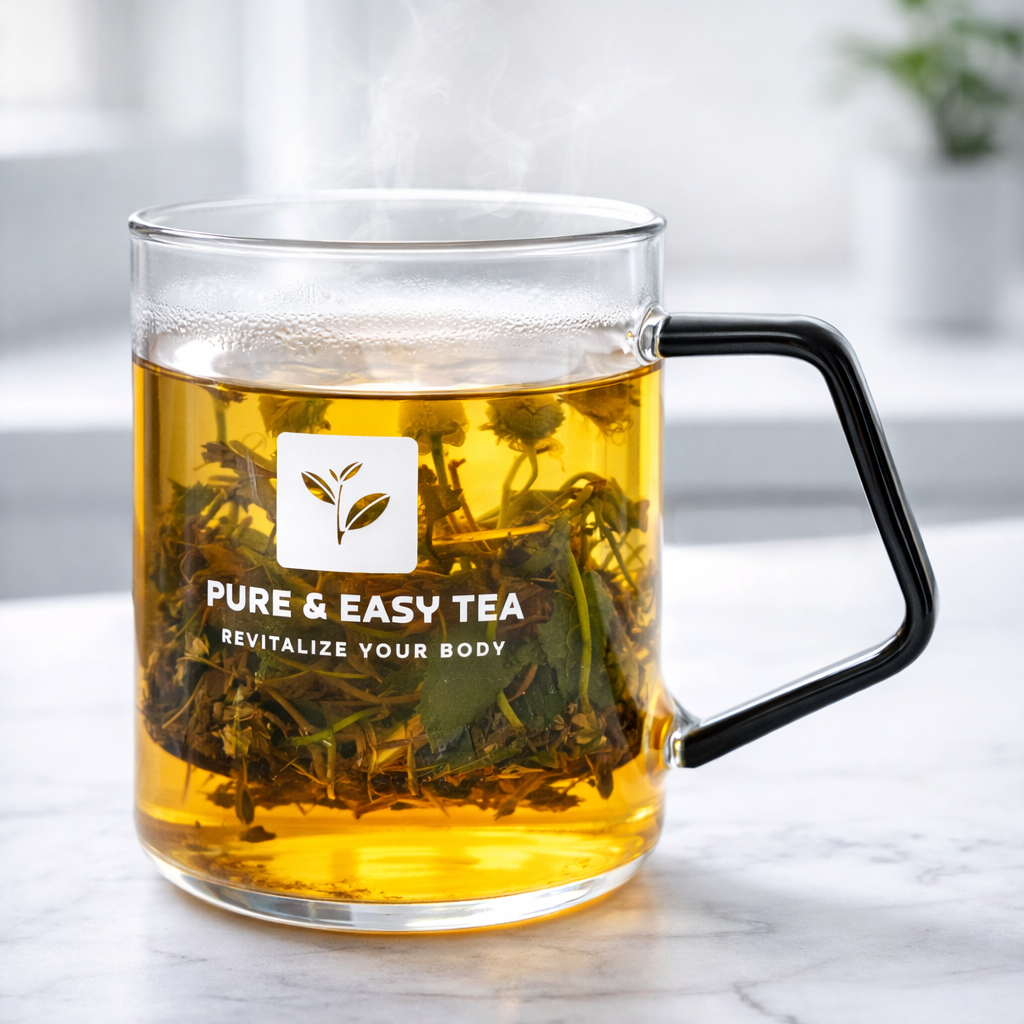
That’s why we brew every cup of Pure & Easy Tea in borosilicate glass.
Borosilicate glass has been trusted for decades in scientific laboratories because it is exceptionally heat resistant, durable, and chemically stable. We appreciate it for many of the same reasons.
It doesn’t absorb flavors.
It doesn’t stain.
It preserves the character of delicate botanicals.
And it eliminates unnecessary plastic contact during the brewing process.
There’s another reason we love brewing in glass.
Watching whole leaves slowly unfurl is part of the experience.
The changing colors.
The movement of flowers.
The aroma released as each ingredient comes to life.
Tea isn’t meant to be rushed.
It’s meant to be experienced.
A simple daily ritual that encourages us to slow down, breathe deeply, and appreciate nature exactly as it was intended.
Prefer the One-Minute Version?
Watch Episode 11 of The Pure & Easy Minute: Do Tea Bags Still Release Microplastics?
See all Pure & Easy Minute episodes »
What Makes a Pure Cup of Tea?
At Pure & Easy Tea, purity isn’t defined by a single characteristic.
It’s the result of thoughtful decisions made every step of the way.
We begin with premium whole botanicals.
We avoid artificial flavorings because real ingredients don’t need imitation.
We source exceptional teas because quality begins at origin.
We prepare every cup in borosilicate glass because how tea is brewed matters just as much as the tea itself.
Every choice reflects the same philosophy:
Remove what isn’t necessary.
Preserve what is.

Building a Better Daily Ritual
The new heart study isn’t a reason to panic.
It’s an opportunity to become more intentional.
Many sources of environmental exposure remain beyond our control.
Others are surprisingly simple to reconsider.
Choose glass whenever practical for hot beverages.
Avoid unnecessarily heating food in plastic containers.
Select whole foods over heavily processed alternatives.
Slow down enough to prepare tea rather than rushing through another disposable cup.
None of these choices guarantee a particular health outcome.
No tea can remove microplastics already present in the body.
And no responsible company should claim otherwise.
But thoughtful habits practiced consistently have a way of shaping healthier lives.
Not because any single decision changes everything.
Because small decisions, repeated every day, become who we are.
Pure Tea Is More Than a Beverage
Science will continue to evolve.
New studies will ask new questions.
Some findings will be strengthened.
Others will be challenged.
That’s how scientific discovery moves forward.
Our commitment to purity doesn’t depend on headlines.
It never has.
From the beginning, Pure & Easy Tea has focused on what matters most: exceptional ingredients, transparent sourcing, mindful preparation, and a brewing experience that honors the integrity of every leaf and botanical.
Because pure tea isn’t simply about what goes into the cup.
It’s about everything that touches it before it reaches you.
Pure Ingredients.
Real Glass.
Nothing Unnecessary.
That’s the Pure & Easy Tea philosophy — and it’s why microplastics are something we design around, not something we ignore.
Nourishing Wellness One Steep at a Time.
Keep reading
What a wonderful article. Both enlightening and inspiring.
I think I need to stop and smell the roses and the tea a little more often!